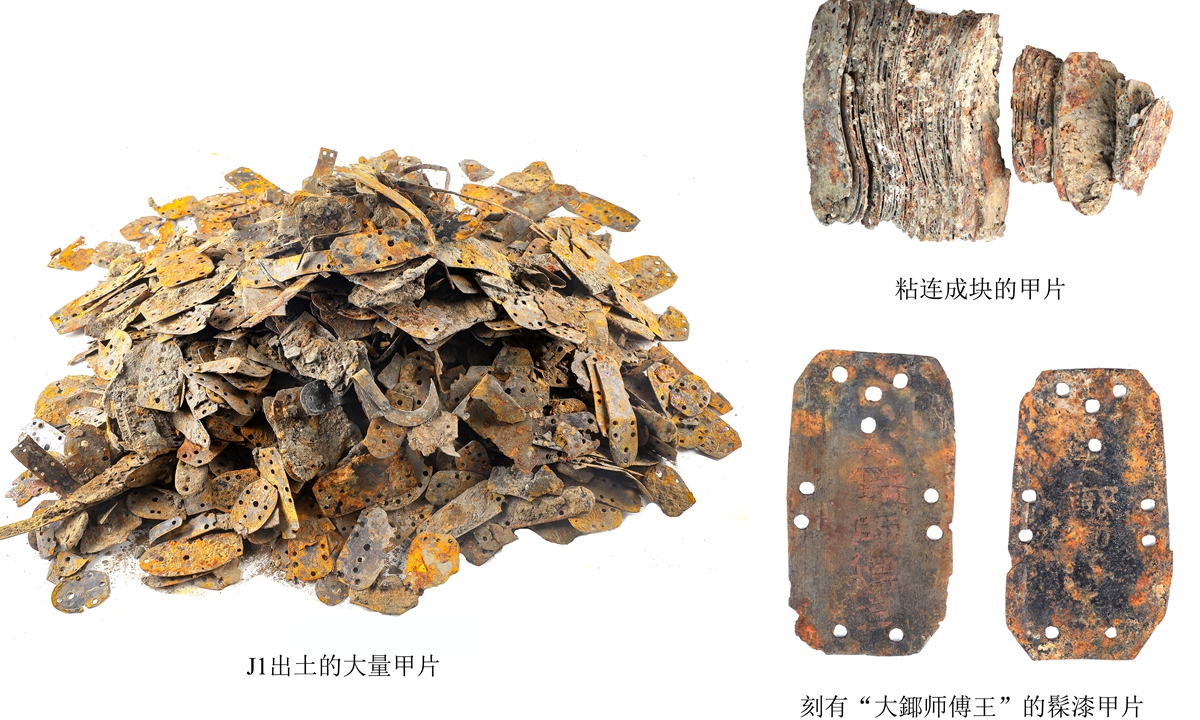
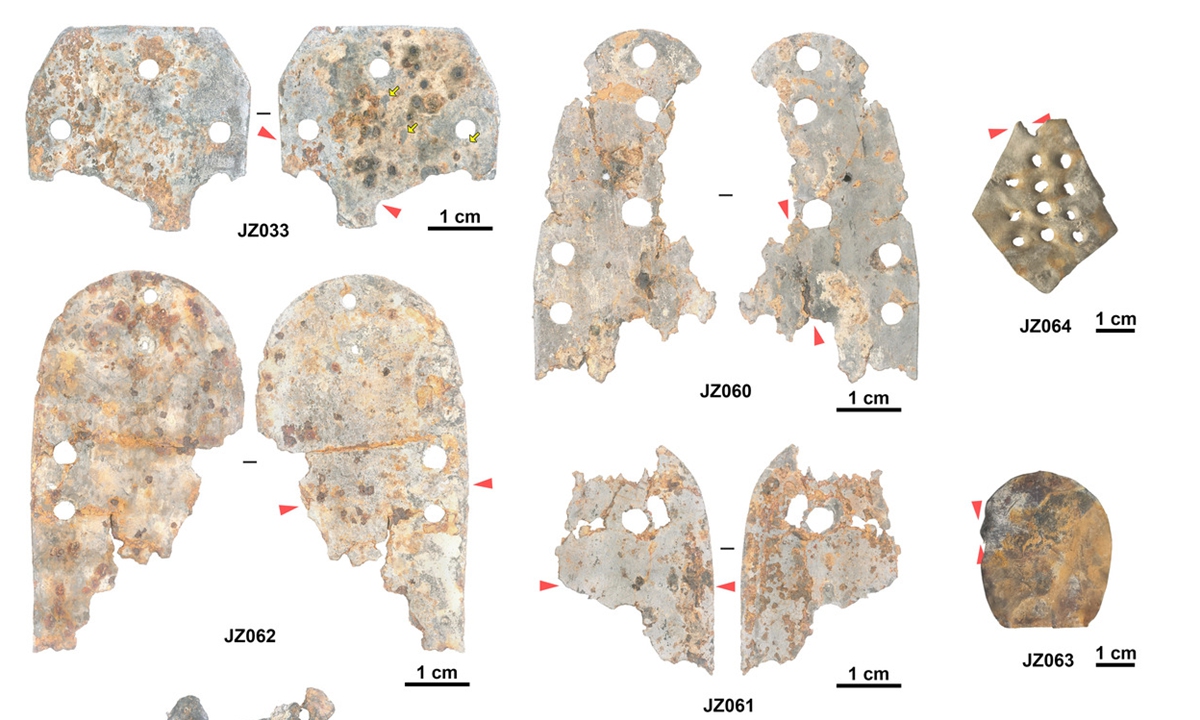
A number of tinned iron armor plates excavated from the Jizhong site Photo: Courtesy of the Shaoxing Institute of Cultural Relics and ArchaeologyArchaeologists at the Jizhong ruins site in Shaoxing, East China's Zhejiang Province, recently unearthed a large number of tinned iron armor plates and semi-finished pieces dating to the Wu period of the Three Kingdoms (222-280), according to the Shaoxing Institute of Cultural Relics and Archaeology. These discoveries represent the earliest known tinned iron artifacts in China to date, as well as the earliest tinned iron production remains found anywhere in the world, proving that an organized, systematic craft industry for tin-plated ironwork existed at that time. While China has a long history of making tinned bronze and tinware, there has long been a lack of reliable historical records or physical evidence to prove early local production of tinned iron artifacts. The newly discovered armor plates can fill this gap, demonstrating that, by no later than the Wu period, local craftspeople in Zhejiang Province had mastered the art of tin-plating iron surfaces. This reflects the region's advanced metallurgical skills at that time, Ge Shuaikun, a researcher at the Shaoxing Institute of Cultural Relics and Archaeology, told the Global Times on Tuesday. Over the last three years, archaeologists working at the Jizhong ruins site have excavated hundreds of tinned iron armor plates from ancient wells and ash pits. A preliminary investigation confirmed that the surfaces of these plates contain high levels of tin. Subsequent laboratory analyses were conducted in collaboration with the Shaoxing's institute and the Institute for Cultural Heritage and History of Science & Technology at the University of Science and Technology Beijing with methods such as Scanning Electron Microscopy with Energy Dispersive Spectroscopy (SEM-EDS), X-ray Diffraction (XRD), and Micro-CT to deeply examine the samples' materials, structures, and technological traces.
Photo: Courtesy of the Shaoxing Institute of Cultural Relics and ArchaeologyAccording to Ge, tin is a non-toxic metal with a low melting point, excellent corrosion resistance, and a silvery sheen. Tin plating effectively prevents rust, making iron armor far more durable and indeed, even after being buried for 1,700 years, many of these tinned plates retain their silvery metallic shine. Research shows that the craftspeople immersed iron armor plates in molten tin, thus ensuring complete coverage of the surface with a continuous tinned layer. This coating isolated the iron from exposure to air and moisture, dramatically boosting corrosion resistance. Many of the excavated tinned armor pieces still show a clear, bright silver-white finish. One major reason for tin-plating the armor was to prevent rust. At the same time, the silvery white shine of tinned iron offered a more striking, beautiful appearance, standing out from the typical dark iron armor of the era. This visual distinction may have marked these pieces as a higher-grade military asset, according to an article from the University of Science and Technology Beijing's official website. The article said that in earlier eras, from the pre-Qin to Han dynasties, tin was widely used as a surface coating on bronzeware and ceramics. Researchers believe the tin-plating of iron armor discovered at the Jizhong ruins site during the Wu period of Three Kingdoms built upon this local tin-coating tradition, representing an adaptation of those techniques across different materials. The process likely benefited from technological exchange among various specialized workshops at the site, including those making bronze castings, iron weapons, and other metallurgical products. 。


 【丁荷·趣】楼梯上的“折叠”餐厅——枣园中二班项目活动
 【大阪マラソン】初マラソンの吉田響は大失速34位 体中の丸テープに注目集まる 田中総監督が説明「柔軟性を出すため」
 普京5.0的首访,给了中国
 That's No Moon: Strange Pulsing Lights Spotted By Airliner Pilot Over North Carolina
 国际海上保险市场因中东战事面临高额赔付
 奥克兰男子的昂贵自行车被盗,提供监控照片及GPS数据后警方拒绝进行调查
 多地有雷阵雨或阵雨,个别地点有暴雨,最高温37℃,河北最新出行信息请查收→
 工商银行、农业银行、中国银行、建设银行,发布公告


